My Primary Roles: Circuit Design & Development, Arduino Programming
Tools: Arduino IDE
Project Context: Electrical Engineering Research Project - Professor Robert Dutton's Lab
Musical Gloves
Using microcontrollers to map hand gestures and musical notes
I spent the summer of 2015 working in Professor Robert Dutton's lab, in Stanford's Electrical Engineering Department. The goal for the summer was to create some form of hardware that would combine music & EE. My lab partner, Alvin, and I both played instruments growing up, so creating a novel musical instrument was something that both of us naturally gravitated towards. We also wanted to make sure that it was portable, and could be designed and implemented within the span of ten weeks. After brainstorming and tinkering around a fair amount, we decided to go forward with the idea of musical gloves.
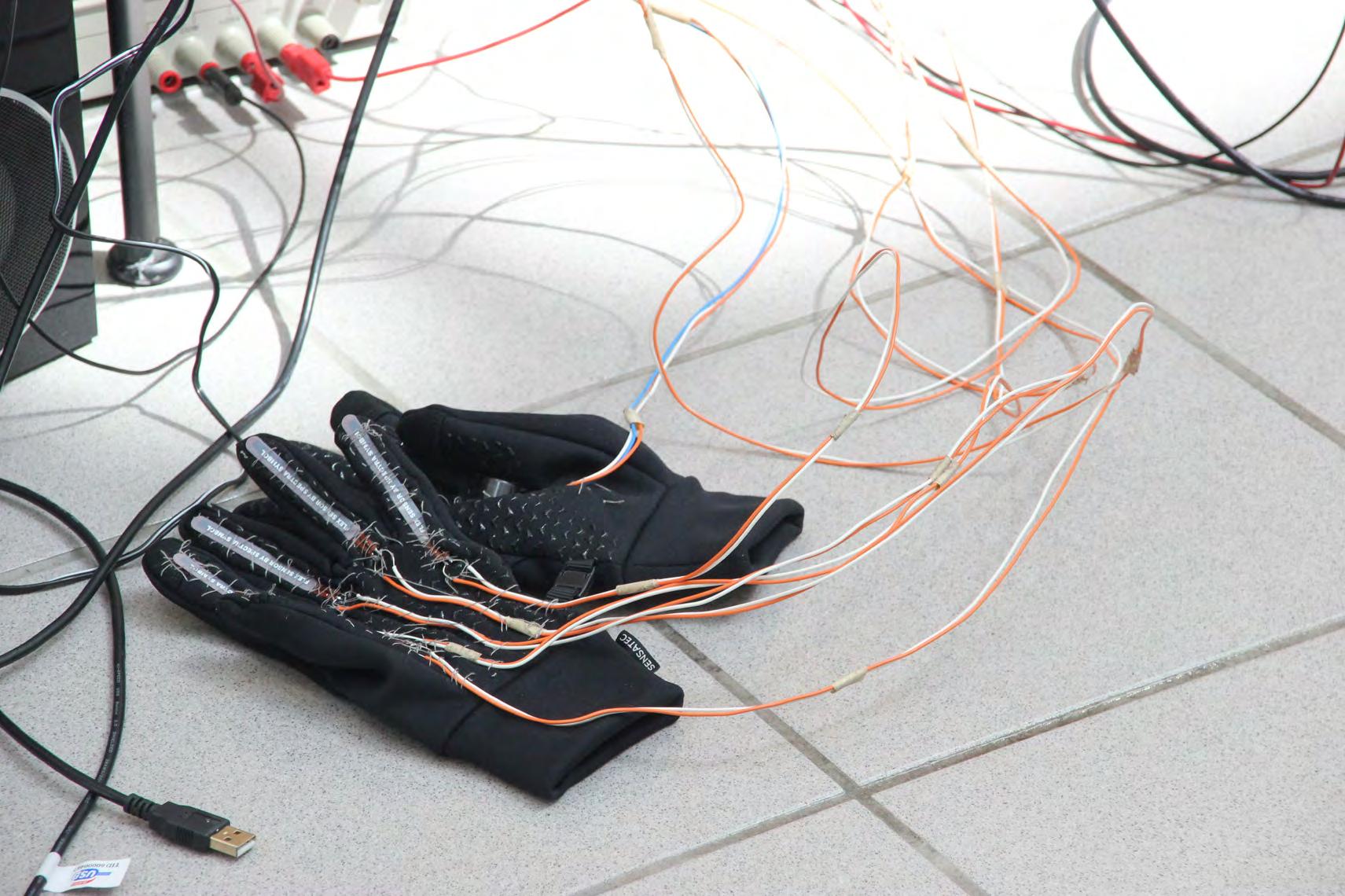
The core of our project used Arduinos and flex sensors. Each finger had a flex sensor attached to it, and the amount a finger was flexed determined the note generated. By combining the different notes produced by each finger, we were able to generate different chords. We programmed the gloves to play notes in the key of A minor, so all the individual notes were in harmony, and we could even jam to a backing track in the same key.
Components:

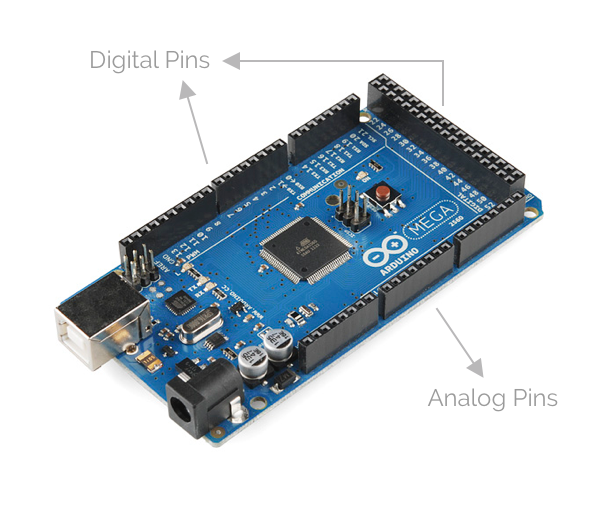
Arduino: The analog pins recorded the voltage values of the flex sensors, which varied according to how much each finger was bent.
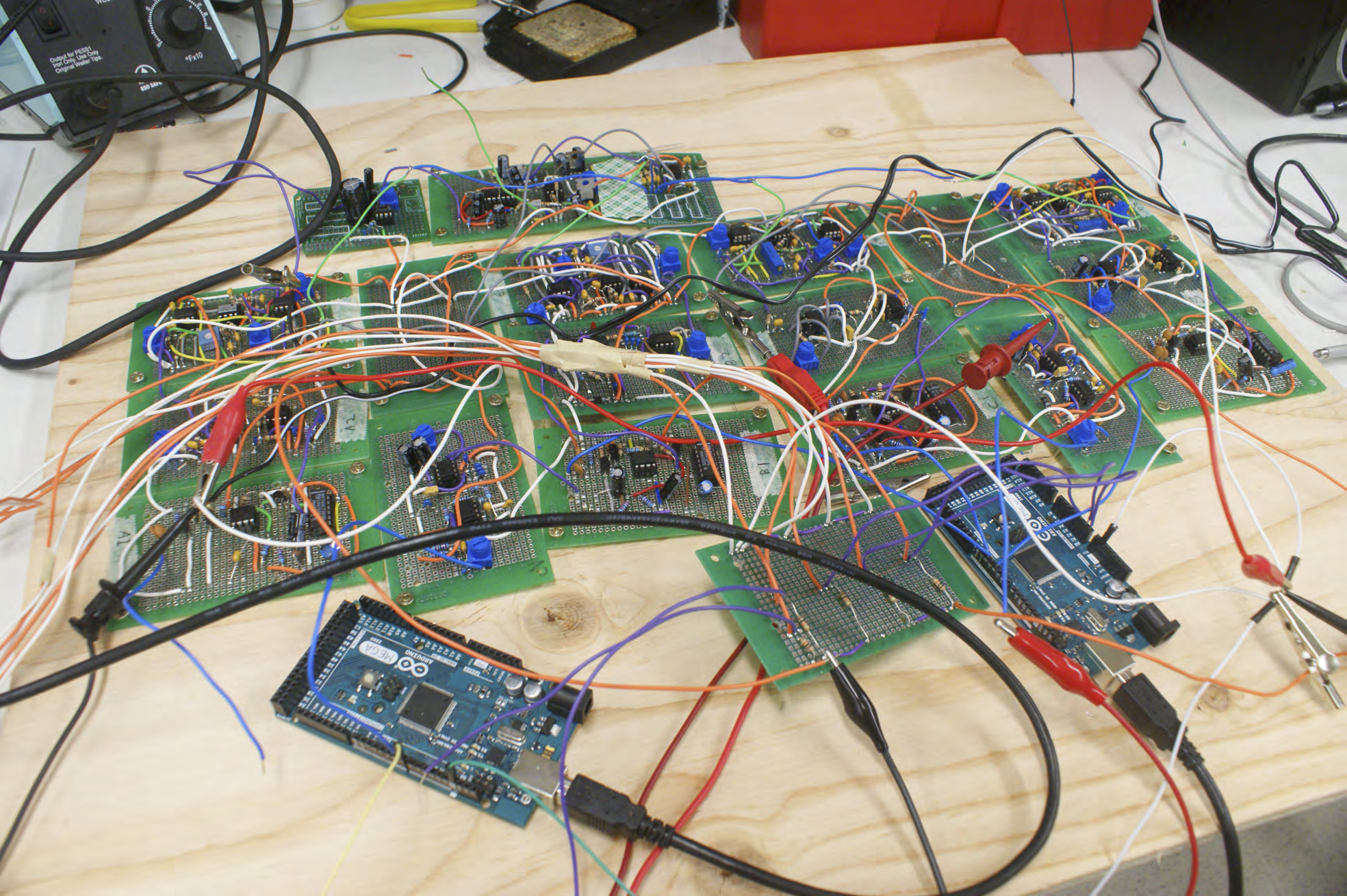
Vibrato: The vibrato circuit modulated the original frequency to emulate the vibrato effect possible on most stringed instruments. We had two flex sensors that could vary the intensity of the vibrato.
Lowpass Filter: The filter cut out lower frequencies and allowed us to modify the Arduino-generated sound, making it sound less computerized and more authentic.
Harmonics Generator: This circuit generated the 2nd and 3rd harmonics of the original frequency, and added a bit of distortion to the sound (once again, to make it feel less computerized).
Summing Amplifier: The summing amplifier combined various tones that were concurrently generated from each finger, thereby creating chords.
Voltage-Controlled Amplifier Power Amplifier: These circuits were used to power the speakers. The VCA also had an ultrasonic sensor attached to it that enabled us to control the volume. The further away the ultrasonic sensor was from an obstacle (such as the table platform), the louder the sound generated. This created a rather cool gestural demonstration of raising one's hand to raise the overall sound volume
Acknowledgements & Takeaways:
Throughout the process of implementing all the stages necessary to create these musical gloves, we developed a profound understanding of circuit design and signal processing. After combining all the different components together, we were able to play our musical gloves and jam to backing tracks in the same key (we settled on the key of A minor, given its fairly understandable note sequence).
In terms of future modifications, it would be interesting to create a wireless system that allows for better glove mobility and ease of use. Creating a printed circuit board to simplify our circuitry would also be a worthwhile venture!
I'd like to say a special thank you to my partner Alvin Kim, Robert Dutton (Professor of Electrical Engineering), Ronald Quan (Radio Frequency Circuit Expert) and Mike Mendoza (Electrical Engineering Masters Student) for their support and supervision during the evolution of this project!